
Award Show and Gala Host Entertainment: Filling the Program Between Segments
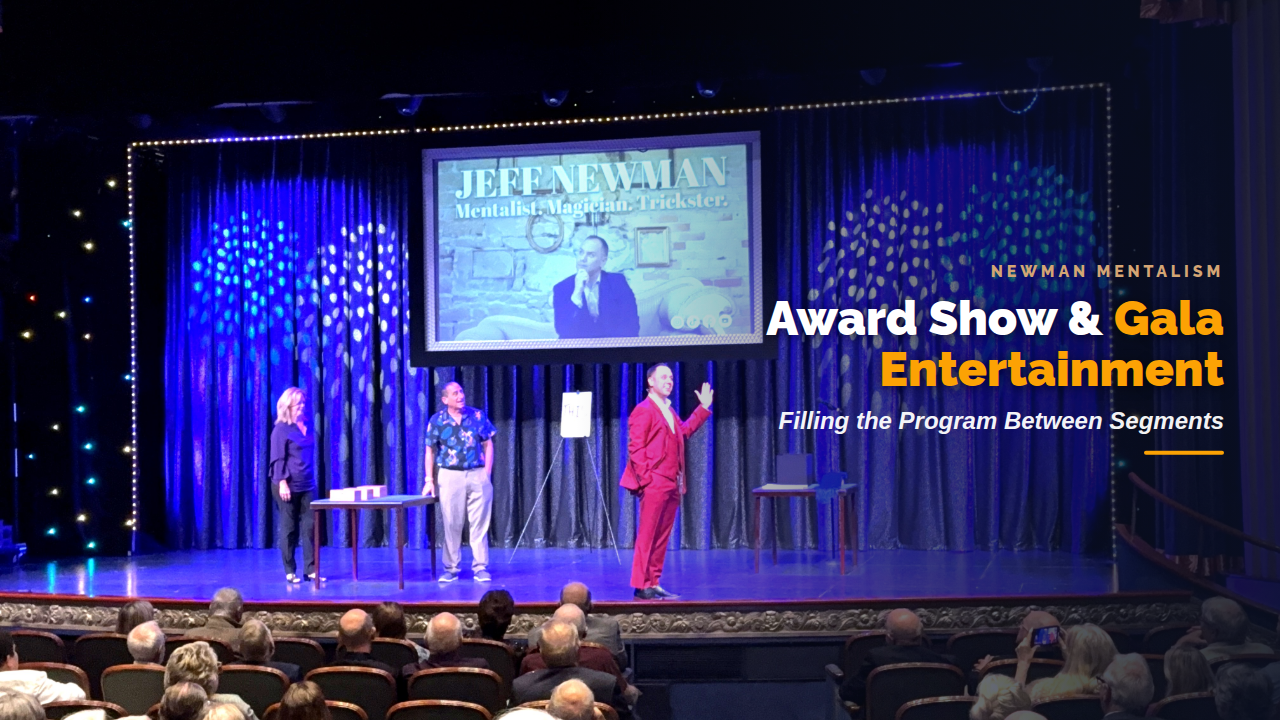
Nobody has ever left an awards night raving about the forty-third trophy presentation. They remember the moment the room laughed together, the moment something impossible happened on stage, and (if the night went badly) the moment the program hit minute ninety and the energy quietly died.
That’s the strange truth about award shows and galas: the program is the reason for the night, but it’s rarely what makes the night feel great. The stuff between the segments does that. And that in-between space is exactly where most events have nothing planned at all.
I’ve performed at galas, award ceremonies, and fundraisers across Canada, from Calgary and Edmonton to Vancouver, Saskatoon, and Winnipeg, and out east to Toronto and Ottawa, and the pattern is remarkably consistent. So here’s a practical look at the between-segments problem, and how the right entertainment fixes it.
Why the Gaps Matter More Than the Program
An awards program is a series of peaks: a winner announced, applause, photos. But between those peaks are valleys, and the valleys add up. Plates being cleared. AV transitions. The walk from the back table to the stage (which takes longer than anyone budgets for). Speeches that run over.
Each gap is small, but a night has dozens of them, and a room’s energy behaves like a leaky tire. Every flat minute lets a little air out, and by the final award, whoever is at the podium is presenting to a room that’s mentally in the parkade.
The events that feel tight aren’t the ones with shorter programs. They’re the ones where somebody planned what happens in the valleys.
What “Host Entertainment” Actually Looks Like
There are a few different jobs that get lumped together here, and it helps to separate them:
The emcee keeps the program moving: introductions, transitions, housekeeping. Often this is an internal person, a board member, or a hired host.
The entertainer delivers planned performance moments: short features between award blocks, or the big one, a featured stage show that anchors the night after dinner or caps the program.
The hybrid does both: hosts the program and fills the gaps with genuine entertainment, so the transitions themselves become part of the show.
All three models work. If your program is short and your internal emcee is a natural, you may only need a single entertainment feature to anchor the night, and I’d rather tell you that on a call than sell you a package you don’t need. But when the program is long (say, more than eight or ten awards), the hybrid or the entertainer-with-features model typically earns its keep, because it turns your night’s biggest liability (the gaps) into its highlights.
And whichever model you land on, the strongest versions of these nights usually share one thing: a proper centerpiece. A featured stage show, placed after dinner or capping the program, gives the evening something to build toward. The features keep the room alive; the centerpiece is what people talk about on the way home.
Where Entertainment Fits in an Awards Program
Having performed a lot of these nights, here’s where entertainment slots in cleanly:
During cocktails or dinner: mingling entertainment at the tables warms the room up before the formal program starts, so the emcee isn’t opening to a cold audience.
As an opener: a short, high-impact set right after dinner snaps the room to attention and buys the first award block a fully engaged audience.
Between award blocks: this is the sweet spot. Two or three short features spaced through the program act like energy resets. Ten minutes of astonishment between blocks five and six does more for the room than any amount of “please hold your applause.”
As a closer: ending on a performance means the night’s last memory is a peak, not a slow shuffle to the coat check.
You don’t need all four. Most galas I work land on one or two of these, matched to the run of show.
Why Mentalism Suits This Job
I’ll admit my bias upfront, but the fit here is structural. Between-segments features have three hard requirements: they need to start instantly (no set changes), they need to land with a mixed formal-event crowd, and they need to end on time so the program stays on rails.
Mentalism checks all three. There’s no equipment reset between features, the material plays clean and smart for a dressed-up adult audience, and a feature can be built to an exact length. It’s also participatory in a way that fits award nights beautifully: the people on stage are your colleagues and honourees having an impossible moment, and they come out of it looking like stars. (If you’re comparing options more broadly, I’ve written about what to book for a corporate award ceremony and how to keep a gala moving past the cocktail hour.)
Planning the Run of Show
A few practical notes from the trenches, whatever act you book:
Alternate blocks and features. Cluster your awards into blocks of three to five, and place short entertainment features between them. The rhythm keeps both the program and the room alive.
Give the entertainment hard time slots, and pick a performer who respects them. A feature that stretches is worse than no feature. Ask any act you’re considering how they handle a program that’s running long; the right answer involves cutting material gracefully, not fighting for their full set.
Let the performer and the AV team talk directly. Mic handoffs and lighting cues between segments are where nights get clunky. I typically deal with the venue’s AV team myself so the transitions are seamless and you’re not relaying messages all night.
Protect the final award. Whatever you do, don’t let the biggest honour of the night land on a drained room. If the program is long, a feature right before the marquee award is the best insurance you can buy.
Frequently Asked Questions
Can you host the whole evening, or just perform?
Both models are on the table. Some clients book a stage show plus features between blocks; others want the full hybrid, where I host the program and weave the entertainment through it. The right choice usually depends on how long your program is and whether you have a natural emcee in-house.
What if we already have an emcee?
That works well. I’ve shared many programs with internal emcees and professional hosts; they run the program, I handle the energy. We coordinate handoffs in advance so the night feels like one show instead of two acts trading a microphone.
Can the entertainment involve our winners and honourees?
Yes, and it’s usually the highlight. Getting an honouree on stage for an impossible moment celebrates them in a way a handshake photo can’t. What I don’t do is roast-style material at anyone’s expense; people leave the stage looking good, full stop.
How far ahead should we book for a gala or awards night?
Gala season concentrates hard around spring and the fall-to-December run, and the strong dates go early. A few months of lead time is usually comfortable; for a December gala, start earlier than that. I’ve covered the timing question in detail in my guide to how far in advance to book event entertainment.
The Night People Remember
An awards night succeeds when the room’s energy at the last award matches its energy at the first. That doesn’t happen by accident, and it doesn’t happen by trimming the program alone. It happens when someone plans the valleys as carefully as the peaks.
If you’re building a gala or awards program and want the gaps working for you instead of against you, get in touch. Bring your draft run of show; I’m happy to point out where the energy will sag before it does.
