
Your Staff Party Outgrew You. Now What?
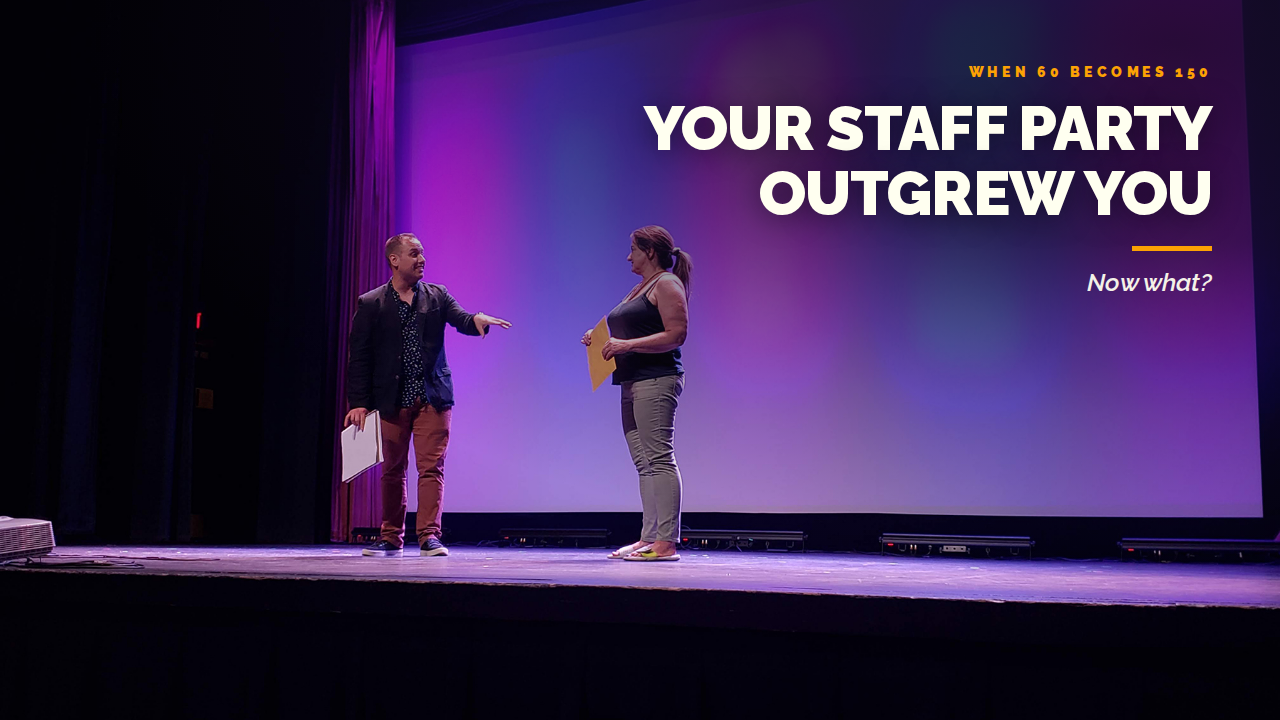
There’s a moment a lot of company parties reach, and it usually arrives without warning.
One year you have 50 or 60 people in a back room. You run a few games yourself, somebody’s playlist handles the music, and everyone has a good night. A couple of years later the company has grown; maybe it was a staffing increase, maybe people were asked to invite their partners, or maybe there are two or three locations coming instead of one. And now, instead of that small group of 50, you’re looking at 150, 200, 300 or more.
The event you ran last time won’t work this time. Not because you did it wrong. Because 150 to 200 people (or more) is a completely different event.
What Actually Changes When the Room Gets Bigger
Sound and sightlines. In a room of 60 you can stand up, raise your voice and be heard at the back. At 150 or 200 the far tables can’t hear you without a microphone, and they can’t see anything that happens below shoulder height. That one fact breaks most homemade programs before anything else does.
Time. A buffet line for 60 moves in about 15 minutes. The same line for 150 or more runs closer to 45, and the people who ate first are finished and restless while the back of the room is still standing up.
Venue class. A group of 60 fits in a restaurant’s back room or an upstairs space at a pub. A room of 150 or 200 needs a hall, a hotel ballroom, a community centre or a banquet room. In Calgary, Edmonton, Vancouver, Victoria, Saskatoon, Regina or Winnipeg, the rooms that hold that many comfortably are a different tier of venue, which means food and beverage minimums, a signed contract and a payment schedule rather than a phone call and a handshake.
The guest list. At 60 you knew everyone in the room and so did everyone else. At 150 (especially if they’re pulled from two or three locations), half the room is meeting the other half for the first time. That’s a good problem, but it doesn’t solve itself.
The Budget Does Not Scale the Way You Expect
The most common mistake at this size is building the budget the way you built the last one.
A 50-person party in a back room runs on a rough number in your head. You know roughly what food costs, the room is probably free or close to it, and if you go over by a few hundred dollars nobody notices. Almost none of that survives the jump. At 150 or 200 nearly everything is quoted per head, the venue carries a food and beverage minimum you have to clear whether or not your people eat that much, and the gap between your estimate and the invoice stops being a rounding error.
The practical effect is that the budget stops being one number and becomes four or five: room, food, beverage, sound, and whatever happens in the middle of the night. Venue and food are the bulk of it and they move in a straight line with your headcount. Everything else is smaller and more flexible.
Entertainment is one line item inside that, and the common mistake is treating it as the leftover at the bottom of the spreadsheet. By the time you get there, there’s nothing left, and the party goes back to being a dinner with a playlist. Decide roughly what the program is worth to you near the start, alongside the venue, rather than at the end. Our guide to what corporate holiday party entertainment costs covers what drives that number.
The Part Nobody Warns You About
If you’re running the program, you’re working the event.
At 60 you could do both. You could call the bingo numbers, hand out the prizes, and still sit down and eat with your people. At 150 or 200 you can’t, and the reason is simple: you’re also the one person in that room everybody wants two minutes with. So the one night a year your whole staff are together, you spend it working.
That’s the real cost of running it yourself at this size, and it isn’t a small one. If you like running the party, keep the parts you like. Just not all of them.
Games and Bingo Do Not Survive the Jump
I want to be fair to the do-it-yourself version, because people in my business usually aren’t. In a small room, homemade games beat a hired act more often than we admit. Inside jokes work. Everybody can hear the instructions. Nobody is watching from 40 feet away.
At 150 and up, the same program runs into problems that have nothing to do with how good the games are. Explaining rules to a room that size takes real effort and a microphone. Prizes for that many people become their own logistics job. The gaps between rounds turn into dead air, and dead air in a big room gets loud. Most of all, the back half of the room stops playing and starts watching other people play, which is a completely different night.
Somewhere between about 80 and 120 guests the homemade program stops holding the room. If you’re still closer to the small end, what works in a smaller room is a different question with a different answer.
What to Hand Off First
The program. This is the biggest time sink you own and the piece that fails most visibly when it fails. It’s also the one thing you can hand to somebody else and get your entire evening back. Whether that’s a mentalist, a comedian, a band or a host who runs the room, the point is that the middle of the night stops being your problem.
Food and beverage. This is what a venue’s minimum is buying you. Let the venue do plate counts, service timing and dietary requests. If you find yourself building a spreadsheet of who ordered what, something has gone wrong.
Sound. Even if it’s only a microphone and a speaker, somebody other than you should own it and test it before doors. A room that size can’t hear a phone speaker or a toast delivered from the middle of the floor.
What stays with you is the part nobody can outsource. The guest list. The tone. Who gets recognized and what gets said about them. The budget. Nobody outside the company can decide who deserves to be thanked from the front of the room, and that’s usually the part people remember longest anyway.
A Timeline for Your First Party This Size
Start in spring for a December event. Yes, that seems too early. Trust me, it’s not. The bulk of my holiday dates are usually booked up by June.
Book the date and the venue together, because at this size they decide each other. Book the entertainment next, before the food details, because a good act on a December date is a much scarcer thing than a caterer. Food and service style come after that, followed by the order of the night. Invitations go out last, with enough notice that people can arrange sitters and shift swaps.
If you’re reading this later in the year with a party to plan, you have fewer options but you aren’t out of them. Weeknight and Sunday dates hold much longer than weekends, and plenty of good rooms are still available in November.
Frequently Asked Questions
At what size should I stop running it myself? There’s no exact number, but the pressure usually shows up somewhere between 80 and 120 guests. The clearer signal isn’t headcount at all: it’s the first year you can’t both run the program and be present as the boss.
If I hire entertainment, do I still need someone to host? Not always. Some performers handle the microphone for the whole middle of the night, introductions and awards included, and some only do their own set. Or, if you or someone in-house can or wants to, there’s no reason you can’t fold that into your plans. Just ask directly which one you’re hiring, because assuming the wrong answer is how a program ends up with a gap in it.
Can I keep some of the games? Yes, and it often works well. Pick the one or two your staff actually ask for, run them early while people are still arriving and eating, and let the show carry the part of the night where a homemade game would sag.
How long should the entertainment be? A typical corporate show runs 45 to 60 minutes. That fits neatly after dinner service and before the awards or the dance floor, and it’s long enough to be the event rather than an interlude.
Our budget only stretches so far. What do we cut? Venue and food aren’t really optional at this size, so entertainment is usually the first discretionary line. You can also spend less on it rather than cutting it entirely, which is a fair move, as long as you go in knowing that you tend to get what you pay for. A cheaper act is usually cheaper for a reason, whether that’s experience, reliability, or how well it works for a room of adults who didn’t choose to be there. In a small casual room you can often get away with it. At 150 or 200 the difference shows up quickly, and it shows up in front of your whole company.
And the trade in cutting the program entirely is real. It usually turns the evening back into a dinner, and a dinner isn’t what people mean when they ask whether there’s a party this year.
What It Looks Like When It Goes Well
Doors open and there’s something to do while people find their tables. Dinner runs on the venue’s timing rather than yours. The middle of the night belongs to somebody you hired, and it holds the whole room, including the tables at the back. The recognition happens when people are still paying attention rather than at the end when half the room has drifted.
And you spend the evening the way you probably imagined it when the party was 50 people, which is with a drink in your hand, talking to your staff.
If your party has outgrown the version you used to run and you want to know what the entertainment side looks like at this size, get in touch.
