
Customer Appreciation Event Entertainment: When Your Clients Are the Audience
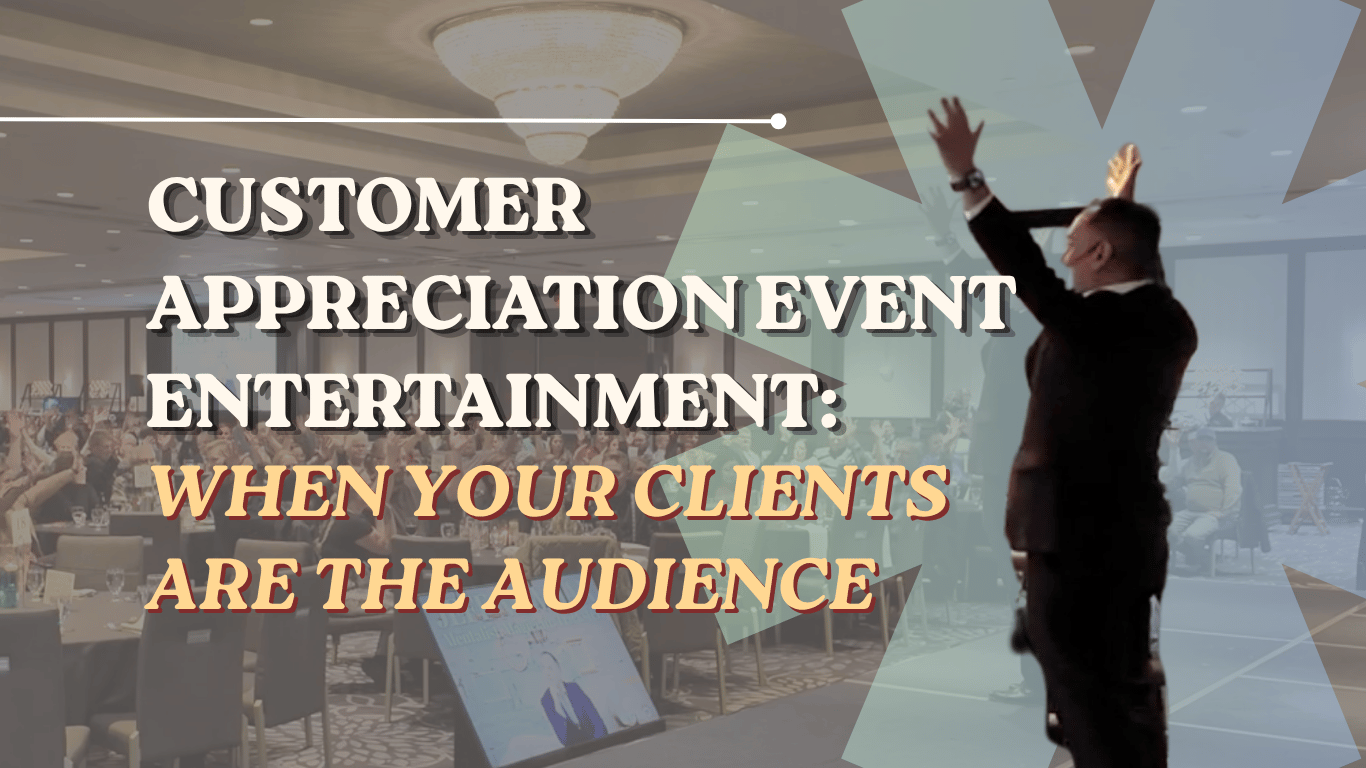
A customer appreciation event is not a holiday party. It is not a sales kickoff. It is not a team dinner.
It is a brand event where your company is the host and your clients are the audience. Everything that happens that night says something about you. The room. The food. The flow of the program. And the entertainment.
I have performed at a lot of customer appreciation events over the years, and the planners who get them right share a single mindset. They treat the night the same way they treat a client meeting: as a moment where the room is making decisions about who your company is. The planners who get them wrong treat it like an internal event with clients invited, and the entertainment lands flat.
Let’s walk through how to think about it.
Why Customer Appreciation Events Are Different
Three things separate a customer appreciation event from your other corporate gatherings.
The audience is paying for nothing and watching everything. Clients arrive with no obligation. They came because you invited them. They notice the dress code, the venue, the host, the staff, the food, and the entertainment. They are forming impressions throughout. A misstep in any segment reads louder than it would at a holiday party where your employees forgive a rough patch.
The stakes are commercial. A successful customer appreciation event reinforces the relationships that pay your bills. A poor one creates the small awkward stories that get told back at the client’s office. Neither directly closes a deal, but both shape the next conversation.
The host is on display. You are not just the planner that night. You are the company’s face. Everything that runs through the program is associated with your brand. Entertainment that feels off-brand will look like you off-brand.
What Your Clients Notice
A few things gala-style audiences and internal audiences absorb differently.
Off-key humour. Internal events forgive an edgy joke from a comedian because everyone in the room understands the context. Clients do not. They don’t know the company culture. They don’t know who’s in the room. A joke that lands at the holiday party can read as inappropriate at the customer event. Clean is non-negotiable here, and it has to feel natural, not forced.
Anything that wastes their time. Clients gave you a Thursday evening. They came over their dinner with their family. A program that drags, an entertainer who can’t read the room and end on time, a host who reads off a printed script for ten extra minutes. All of these feel longer at a client event than at an internal one. Tightness matters.
The way they’re treated personally. If your entertainment involves the audience (close-up performance during cocktails, mentalism that picks someone for a routine), the way that volunteer is treated is the way a client just got treated by your brand. A volunteer who feels great is a client who feels great. A volunteer who felt embarrassed is a client with a story.
Whether you respected them. Smart audiences appreciate smart entertainment. Treating a room of senior client executives like they need broad humour reads as condescending. The entertainment should treat the room like adults who chose to be there.
What Works for a Client Audience
A few patterns from years of customer events.
Interactive without being intrusive. Clients respond well to entertainment they’re a part of, but they don’t want to be pulled out of their chair against their will. The best formats give clients the option to engage at their comfort level. Close-up performance at cocktails works because the audience opts in. A stage show that requires hauling a senior VP onto the stage does not.
Clean and confident. PG by default. Smart by tone. Confident in delivery. Clients can spot a performer hedging.
Brief, not exhaustive. A 30 to 45 minute headline set is more than enough. Hour-long stage shows at a customer event push the program past where the room is willing to sit.
Memorable in a positive way. The goal is for clients to be telling someone about the entertainment the next morning. Not because it was extreme, but because it was a moment worth describing. Quiet astonishment beats loud spectacle.
Mentalism, as a format, suits client audiences well. It’s interactive without being aggressive, it gives the volunteer a positive experience by design, and it creates moments people describe to their colleagues. But the criteria above apply regardless of format. Hire by criteria.
Where Entertainment Fits in a Customer Event
A typical customer appreciation event has a few structural slots where entertainment can land.
The cocktail reception. Clients are arriving in waves, getting drinks, finding each other. Roving entertainment in this slot acts as both an icebreaker and a brand experience. A close-up performer working table to table during cocktails will end up working with 80 percent of the room by the time dinner is called.
Pre-dinner welcome. Some events open with a host welcoming guests and a brief moment of programmed content. A short performance (10 to 15 minutes) can frame the evening if the venue and timing allow. Not always necessary.
Between courses or after dinner. The classic slot. A 25 to 45 minute headline performance between dinner and dessert, or after dessert before mingling. This is where the highest-impact moments happen.
Closing slot. Brief and intentional. A short performance to end the formal program before clients drift to mingling. Good for events with a longer program before this slot. Less useful at smaller events.
For most customer events, the strongest configuration is roving entertainment during cocktails plus a headline performance after dinner. The roving sets the tone. The headline gives the night its memorable peak.
Common Customer Event Entertainment Mistakes
A few patterns I see go wrong.
Treating it as a holiday party with clients invited. A holiday party is a celebration where your team forgives small misfires. A customer event is a brand experience where your clients judge them. The booking choice should reflect the difference.
Hiring on price. Customer events are the wrong place to save money on entertainment. The night is built around clients you have spent years cultivating. Spending less on entertainment to save a few thousand dollars almost never pencils out against the lost impression cost.
Letting the host overshadow the entertainment. A senior leader at the company who insists on doing 20 minutes of unprepared remarks before the entertainment can sink the program. The entertainment is what clients will talk about. The remarks are what clients will tolerate. Plan accordingly.
Forgetting the room is mostly seated for the headline. Clients at a customer event are not the same physical configuration as a holiday party crowd. They are seated, eating, and being attentive in a specific way. A high-energy stand-up act built for a comedy club room may not land in a hotel ballroom with a seated, alcohol-light, attentive audience.
Letting the entertainment require client volunteers who’d rather not. A pro reads the room and picks people who want to participate. An amateur grabs the first hand up and forces it. At a customer event, the cost of forcing an unwilling volunteer is higher than the entertainment is worth. Hire performers who handle audience interaction with care.
Questions to Ask Before You Book
A short customer-event-specific vetting list:
Have you performed at customer appreciation events specifically, and what was the format? If the reel is all holiday parties or comedy clubs, that is information.
How do you handle audience interaction so the volunteer always leaves feeling good? The right answer is specific, not generic.
Are you willing to brief on our company, our industry, and our client base so your set fits the room? A pro asks for this without prompting.
What’s your standard set length, and can you flex 15 minutes either direction? Customer events drift. Flex is non-negotiable.
Are you insured, PG by default, and do you have video from a comparable event? All yes, without hesitation.
Will you stay for mingling after the show? Some performers do, some don’t. Either is fine. Worth knowing.
What does your wardrobe look like for a corporate-formal client event? Should match the dress code of the room.
Make the Event a Brand Moment
A customer appreciation event is one of the few times every year where a meaningful number of your clients are in the same room, paying attention to you. The entertainment is one of the things they’ll remember about the night.
Treat it like a brand expression. Pick a performer who reflects well on you. Brief them on the audience. Pace the program for clients, not for employees. And book early, because the right performer for a client event is rarely available on short notice.
If you are planning a customer appreciation event in Calgary, Edmonton, Vancouver, Toronto, or anywhere else and you want entertainment that reflects well on your brand, I would love to hear about it. Tell me about your event on the corporate entertainment page, and we’ll see if I’m the right fit.
