
How Far in Advance Should You Book a Magician? (A Corporate Planner's Guide)
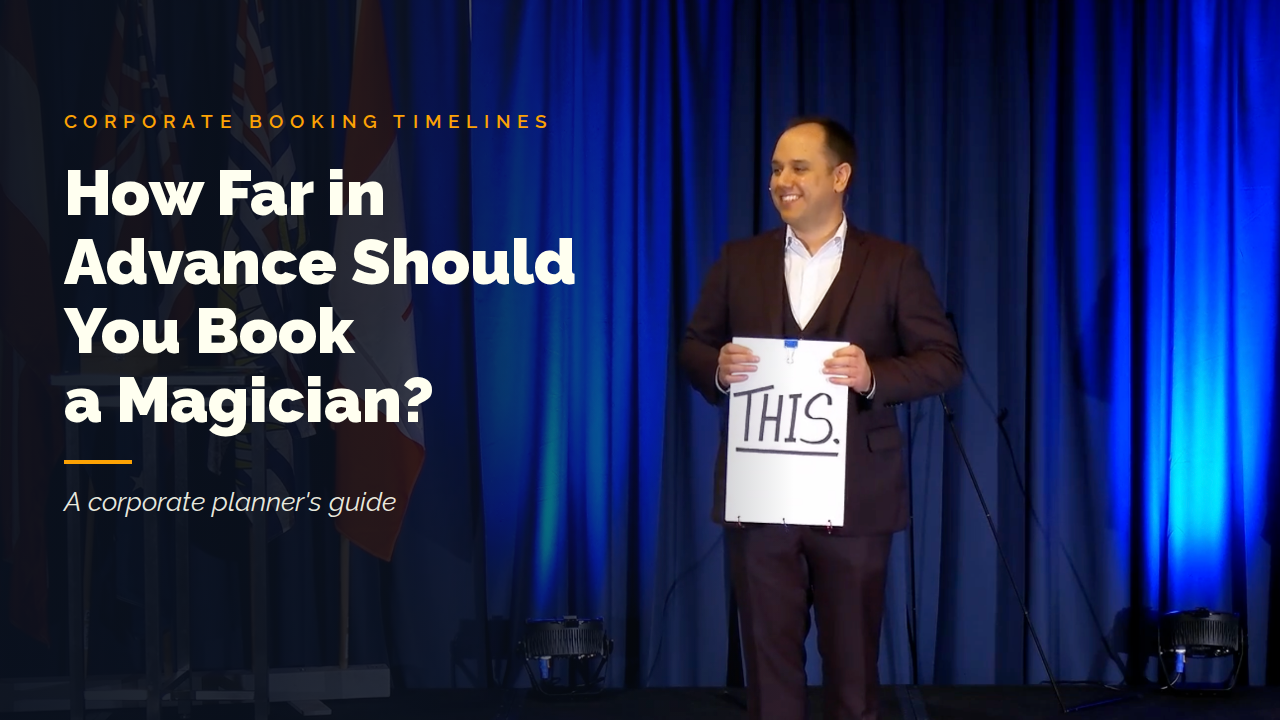
How far in advance should you book a magician for a corporate event? Sooner than most planners expect.
The longer answer depends on what kind of event you're running and, more than anything else, whether it happens in December.
As a mentalist, I perform at corporate events across Canada year-round, so I hear this question on almost every call. Here's the timeline I actually give planners, event type by event type. (If you're planning a wedding or a private party, some of the same logic applies, but since I mostly perform for corporate audiences, this guide is written for corporate events.)
How Far in Advance to Book, by Event Type
December holiday parties: start in the spring, or even earlier. Yes, that seems too early. Trust me, it's not. The bulk of my holiday dates are usually booked up by June, and I'm far from the only one.
Conferences and conventions: 6 to 12 months out. Most conference programs get built well ahead, and the entertainment slot is easiest to fill when it's planned alongside the rest of the agenda rather than after it.
Galas, fundraisers and awards nights: 6 months or more for the strong dates. Gala season concentrates around spring and the fall-to-December run, so you're competing with more events than you might think.
Everything else: client appreciation events, AGMs, staff parties outside the holiday season. A few months of lead time is normally comfortable, and midweek dates in quieter months can sometimes come together faster than that.
One thing booking early typically doesn't change: the price. An experienced performer's fee is generally the same in March as it is in October (I've broken down how much a magician costs in Canada separately). What changes is what your budget can get you. Booking early means you're choosing from the full field instead of whoever still has your date open.
Why December Is Its Own Calendar
A company holiday party competes for dates in a way no other corporate event does. Every company in the country is trying to fit its party into the same 3 or 4 weeks, and most of them want the same Friday and Saturday nights.
It gets tighter than that for performers who travel. I'm based in Calgary, but my December calendar is one calendar. A Friday night that goes to a party in Winnipeg isn't available in Calgary, Edmonton, Vancouver, Victoria, Saskatoon or Regina, and the same is true in reverse. You're not just competing with other companies in your city for entertainment; you're often competing with companies everywhere the performer works.
It also starts earlier than most people would guess. The first holiday inquiries of the year start reaching me in January, sometimes within a couple of weeks of the previous season's decorations coming down. Many of those are returning clients claiming their date for next year before anyone else can. (For the bigger picture on the whole category, I've put together a holiday party entertainment page.)
The Holiday Season, Month by Month
January to March: inquiries start arriving. The earliest bookings tend to be returning clients and larger companies with event teams that plan a year at a time. There's no prize for being first, but this is when the calendar starts filling.
Spring: the real-choice window. Book between about March and May and you can typically still choose the date, the format and the act, all at once. This is when I'd recommend booking, and I'm aware of how early that sounds.
June: the tipping point. By the end of June, the bulk of my December dates have typically been claimed, and most established performers I know would say something similar.
July and August: weekends thin out. There are still good dates available, but "the good dates" and "the dates you had in mind" start becoming different lists.
September and October: the premium Friday and Saturday nights are mostly gone. Weeknight parties hold out longer, which is one reason they're worth considering anyway. I've made the case for weeknight holiday parties separately.
November and December: at that point it's not really a planning-ahead question anymore. Options still exist, especially midweek, but you're working with what's still open rather than what you'd have picked in the spring.
Conferences, Galas and Awards Nights
Conference entertainment tends to get decided when the program gets built, which can be 6 to 12 months out for a larger event. The entertainment is typically the banquet feature or the closing night, and booking it alongside the venue and speakers (rather than a few weeks before) means AV, staging and the run of show get sorted once instead of twice.
Fundraising galas add a wrinkle: committees. If entertainment needs committee approval, add the length of your meeting cycle to every timeline in this guide. Awards nights behave like galas, with the added pressure that they're often tied to a fixed annual date that can't move to wherever the calendar is open.
That points to a rule that applies year-round. A fixed, immovable date deserves more lead time than a flexible one. If the event has to happen on one specific night, treat it like a December booking and start early, whatever month it's in.
The Rest of the Year
Not every corporate event is fighting the December calendar. Client appreciation nights, AGMs, staff socials, summer events: for most of these, 2 to 4 months of lead time is typically comfortable, and there's often more flexibility than that for midweek dates. January and February parties in particular have become a popular alternative to December, partly because the whole calendar (venues included) opens back up.
What Booking Early Actually Gets You
The obvious part is availability. The less obvious part is everything that comes after the date is held: time to sort out the right format for your room (a full stage show, mingling entertainment during a reception, or both), a chance to talk through content and tone, and no countdown running while AV and staging details get handled. None of it is complicated. It's just all easier when nobody's rushing.
There's a limit in the other direction, though. You can reach out too early. Until you have a date, or at least a short list of dates, there isn't much for an entertainer to hold. Lock the date first, then book the things that can only be in one place at a time (the venue and the entertainment), and let catering, decor and invitations flex around those. If you want to see what the booking itself involves, I've walked through what booking a mentalist actually looks like, from first email to show night.
FAQs
Is spring really not too early to book December entertainment?
It's not. Spring bookings for December are normal in this industry, and for weekend dates they're closer to the rule than the exception. If anything, waiting until early fall is the riskier option, because by then the premium dates are usually gone.
We just got our budget approved in the fall. Are we too late?
For a December weekend, possibly, at least for your first choices. For a December weeknight, there's more room. And for an event happening any other time of year, not at all. Fall is a comfortable time to book a winter or spring event.
How far in advance should we book entertainment for a conference?
Aim for 6 to 12 months, ideally while the venue and speakers are being confirmed. For a smaller conference or a single banquet slot, 4 to 6 months is often workable.
What does it take to actually hold a date?
For most professional entertainers, a conversation about the event, a signed agreement and a payment schedule. The specifics vary from performer to performer, and the booking guide linked above walks through what that process looks like with me.
Where to Start
If your event is in December, start now, whatever month it is when you're reading this. If it's any other time of year, a few months out is usually enough, and a fixed date deserves more.
Planning a corporate event in Calgary, Edmonton, or anywhere across Canada? Jeff Newman delivers a show that will have your guests talking long after the night ends. Visit the corporate events page to learn more, or get in touch directly through the contact page.
