
How to Evaluate an Event Entertainer’s Demo Reel: A Planner’s Guide
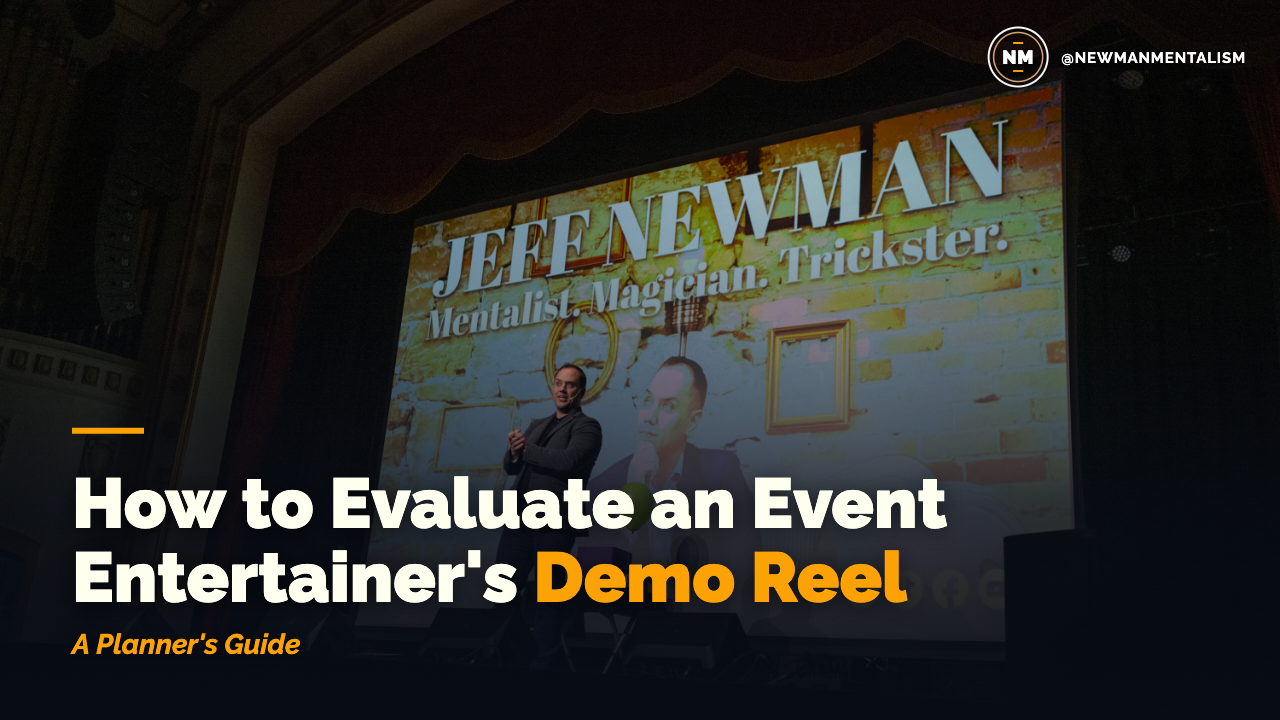
A demo reel is the single piece of evidence most event planners watch before deciding whether to book a performer. It’s also the piece of evidence most planners don’t know how to evaluate.
Demo reels are designed to make the performer look good. That’s their job. The question for a planner isn’t “does this person look good in their reel” (everyone does) but “what is this reel telling me, and what is it hiding.”
After years of having my own reel watched by planners and watching other performers’ reels evaluate other bookings, I’ve learned what to look for. Here’s a practical guide.
The Three Questions Every Reel Should Answer
Before getting into the weeds, here’s the high-level framework. A demo reel exists to answer three questions:
Can this performer do the thing they say they do?
Does it look like something my audience would enjoy?
Is this performer reliable in a corporate room?
If a reel doesn’t give you a confident yes on all three, the reel isn’t doing its job. Sometimes that’s the reel’s fault. Often it’s the performer’s.
Green Flags: What a Strong Reel Shows
Audience reaction shots, not just performer shots. A reel that’s all close-ups of the performer’s face is telling you the performer wants to look good. A reel that includes audience reactions (real laughter, real astonishment, real engagement) is telling you the show actually worked. Look for the audience.
Multiple events, not one. A reel built from clips at five different events is more credible than a reel built from one event shot heavily. Different rooms, different audiences, different lighting. A pro has variety in their reel because they have variety in their bookings.
Comparable-event footage. If you’re booking a corporate gala, you want to see footage from a corporate gala. Not a wedding. Not a comedy club. Not a college campus. Comparable footage is what tells you the performer can do what you need.
Recognizable client names or settings. A reel that includes recognizable corporate logos, hotel ballrooms, association brands, or other markers of real corporate work is credible. A reel shot entirely at the same venue, same lighting, same audience demographic is less credible.
Footage that’s recent. Within the last two years is the safe range. Three years is the edge. Older than that, the performer’s set, look, and chops may all have changed.
Audio that captures the room. Real audience laughter, real gasps, real applause. Not added in post. You can usually tell the difference. Real room sound is a green flag.
A long-form clip somewhere on offer. A polished 90-second highlight reel is fine for first impressions. A pro will also have a longer clip (5 to 15 minutes of an uninterrupted segment) available on request. The longer clip tells you whether the performer can hold a room across more than soundbite moments.
Red Flags: What to Be Suspicious Of
Heavy editing with rapid cuts. A reel cut every 1 to 3 seconds is hiding something. Either the performer doesn’t have long stretches of genuinely good footage, or the editor is masking weakness with kinetic editing. A pro’s reel can breathe because the source material can breathe.
Music covering the audio. A reel with a music track over the entire run, drowning out audience reaction and performer audio, is hiding something. Music is fine in some moments. Wall-to-wall music covering up the actual show audio is a red flag.
No audience faces. A reel that carefully cuts away from the audience every time is hiding the audience’s response. Either there wasn’t much response, or there were issues with the audience that the performer doesn’t want shown.
Identical-looking events. A reel that looks like every clip was shot at the same casual room with the same audience configuration tells you the performer hasn’t worked broadly. That’s an experience signal.
Only stage-show footage when you need close-up, or vice versa. A reel that doesn’t show the format you’re hiring for can’t tell you the performer does that format well.
No on-camera moments with the audience. A reel that’s all performer-on-stage and no shots of the performer interacting with audience members is hiding how the performer handles audience contact. For corporate events where the performer will interact with attendees, this matters.
Promo-style narration over real footage. A voiceover saying “audiences love Jeff’s amazing shows” over edited highlight clips is a marketing exercise, not evidence. Watch for this. The reels that don’t need narration are the reels that have the goods.
Comedy-club bricks or working-blue moments. If you’re booking a corporate event and the reel includes clips from a comedy club where the performer is working blue, the performer is either telling you “I do this too” or doesn’t realize the corporate audience is watching the same reel. Either is a problem.
What to Ignore (Even Though It Feels Important)
Production quality. A well-shot reel is a nice-to-have, not a deal-breaker. Some excellent performers have mediocre reels because they haven’t invested in production. The performance matters more than the gloss.
Client logos as wallpaper. A wall of logos at the end of the reel is impressive at a glance, but it doesn’t tell you what those clients hired the performer to do. The performance footage matters more than the logo wall.
Awards and credentials in supers. “Award-winning” graphics in the title card are easy to add. The performance matters more.
The performer’s confidence on camera. Some great corporate performers are camera-aware. Some are not. A reel where the performer mugs at the camera doesn’t tell you whether they can hold a corporate ballroom.
What to Do When You Can’t Tell
Three options.
Ask for a longer clip. Send an email saying you watched the reel and you’d like to see a longer uninterrupted segment from a comparable event. A pro will send it within a day. An amateur will hedge or claim the longer footage isn’t available.
Ask for a recent reference. Someone who hired the performer in the last 12 months at a comparable event. Take the reference call. Five minutes of conversation with a real client beats 90 seconds of polished highlights.
Ask the performer to walk you through one moment. Pick a moment from the reel and ask the performer to explain what was happening, what the audience response was, and what the planner asked them to do at that event. A pro can talk through their own work credibly. An amateur or a performer leaning on outdated reel material cannot.
For more on what separates pros from amateurs across the whole booking process, see the Pro vs Amateur piece.
When the Reel Tells You to Walk Away
A few combinations that should end the conversation.
Heavy editing, no audience footage, music over everything, and only one venue. The reel is hiding too much.
The performer can’t provide a longer clip on request. They don’t have one because the source material isn’t good enough.
The performer’s social media or website video looks dramatically less polished than the reel. The reel has been over-produced beyond the actual performance level.
The reel is more than three years old and no recent footage exists. Something has shifted in the performer’s work and they don’t have footage to show it.
References go unanswered or only put you in touch with friends or family.
Trust the Reel, but Trust the Conversation More
The demo reel is a useful filter. It’s not a decision. The booking conversation that follows tells you almost as much as the reel does. A performer whose reel is strong and whose follow-up conversation is sharp is a credible hire. A performer whose reel is strong but whose follow-up is vague, slow, or evasive is not.
If you’re vetting entertainment for a corporate event in Calgary, Edmonton, Vancouver, Toronto, or anywhere else and want a second opinion on a reel you’ve watched (mine or anyone else’s), I’m happy to talk you through it. Tell me about your event on the corporate entertainment page, and we’ll go from there.
