
The Difference Between a Mentalist and a Psychic (And Why It Matters at Your Corporate Event)
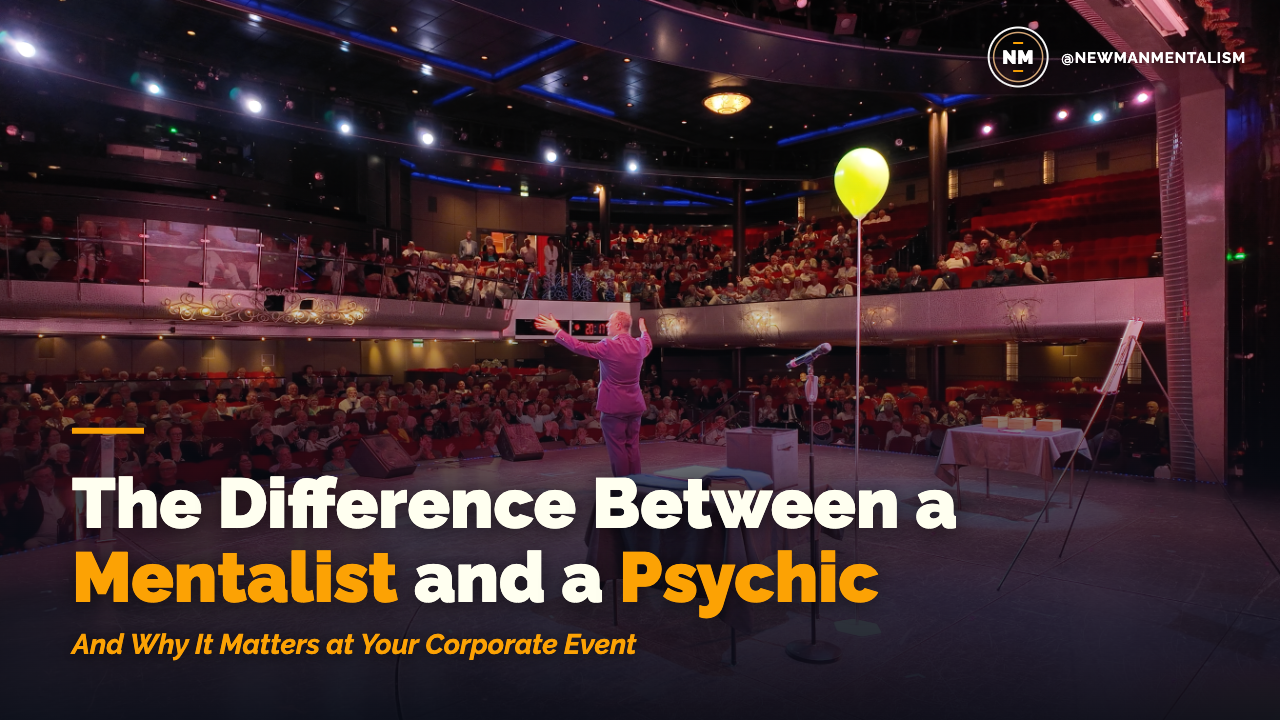
I get asked the same question after a lot of corporate shows.
"Are you actually psychic?"
The honest answer, always, is no. I'm a performer. Mentalism is a performance art, like magic. The audience experiences the impossible, but the impossible is built on methods, technique, and showmanship. I don't claim a real gift. I claim a good show.
It surprises people that the answer is no, because there's a whole category of performers (and people charging for personal sessions) who do claim real psychic ability. The lines between psychic acts, mediums, fortune tellers, and stage mentalists have blurred enough over the years that most corporate planners can't tell the difference at the booking stage.
It matters. Here's why.
What a Psychic Claims
A psychic, in the conventional use of the word, claims to have real supernatural ability. They can read minds, see the future, communicate with the dead, perceive auras, sense energies. The framing is: this is a real gift, not a trick.
That framing has consequences.
Many psychics charge for personal sessions, where they offer guidance, predictions, or messages to individuals. Some of those sessions land harmlessly. Some don't. People in vulnerable moments (grief, anxiety, big life decisions) can act on guidance from a stranger claiming supernatural sight, and the outcomes range from useless to harmful.
Some psychics do stage shows as well, using the same framing. The audience is told the performer is genuinely communicating with spirits, sensing energies, or seeing the future. The show works because the audience believes the framing.
A psychic act, by definition, depends on the audience taking the supernatural claim at face value.
What a Mentalist Is
A mentalist is an entertainer. Mentalism is a performance art that uses methods (the same toolkit magicians use, plus some specific to the format) to create the experience of mind reading, prediction, and influence on stage.
The audience watches a mentalism show knowing, or at least suspecting, that it's a performance. The performer doesn't claim to be reading anyone's mind for real. The contract with the audience is closer to magic than psychic reading: the performer is doing something that looks impossible, and the audience is invited to enjoy the impossibility without being asked to believe it's literal.
The methods stay private (that's part of the format), but the framing is clear. Mentalism is entertainment, not a supernatural service.
A few characteristics of a working mentalist:
They describe what they do as a performance, not a gift.
They don't sell personal sessions claiming to predict your future or contact deceased relatives.
They have a tech rider, a contract, and a corporate booking process like any other performer.
They can adapt the show to the room, vary the routines, and flex with the program.
They don't make claims they can't back up with showmanship.
Why the Distinction Matters at a Corporate Event
If you're booking entertainment for a corporate event, the difference shows up in a few places.
Brand safety. A performer who frames themselves as "really" psychic introduces brand questions you don't need. Skeptical executives may roll their eyes. Religiously observant attendees may be uncomfortable. Risk-averse HR may ask questions. A mentalist who is upfront about being a performer sidesteps all of that.
Audience comfort. A corporate audience watching a psychic act may include individuals who came to find personal answers. The performer who promised supernatural insight at the booking stage now has audience members expecting it. The performance can drift in directions you didn't plan.
The show itself. Mentalism shows in the corporate context tend to be tighter, more controlled, and more programmed than psychic-framed acts. The performer knows exactly what's happening on stage and can pace, time, and adjust. Psychic-framed acts depend on the audience believing the framing, which constrains what the performer can do.
Reputation downstream. The corporate community remembers. Booking a performer who framed themselves as supernaturally gifted, who then created an uncomfortable moment with a vulnerable audience member, becomes a story that follows the planner around. Booking a clean mentalism performance does not.
How to Tell the Difference When You're Vetting
A few signals in the booking process.
Read the marketing. A performer who claims real psychic ability will say so prominently. "Born with the gift." "Real psychic." "Genuine medium." A mentalist will describe their work as performance art, showmanship, or entertainment.
Look at what they sell. A performer who only does stage shows and corporate events is operating in the entertainment space. A performer who also sells personal readings, predictions, or contact-with-the-dead sessions is operating in a different category, even if their stage show is technically mentalism.
Read the testimonials. Mentalists collect testimonials from event planners, corporate clients, and theatre bookers. Psychics collect testimonials from individual clients about predictions that came true or messages received from loved ones. The pattern of social proof tells you a lot.
Ask directly. "Do you claim to have real psychic ability?" A mentalist will answer no. A psychic will answer yes. The clarity matters.
For more on what separates a pro from an amateur across the full booking process, see the Pro vs Amateur piece.
When the Lines Blur
Some performers blur the lines.
A psychic-framed act may technically use mentalism methods but stays in supernatural framing because the audience prefers it that way. A mentalist may use mystical or theatrical framing on stage without making real claims, in a way that lands somewhere between the two.
For corporate bookings, the safe move is to pick a performer who is clearly on the mentalism side of the line. The framing is unambiguous, the brand safety is intact, and the show is the show.
What to Look for When You Want Mentalism
If you've decided mentalism is the format you want for your corporate event, here are a few things to look for.
A performer who calls themselves a mentalist or performer, not a psychic. Sounds basic. Not all of them do.
Corporate-event video, not personal-reading video. The reel should show stage work for corporate audiences, not testimonials from individuals about personal sessions.
A tech rider, an LOA, and a corporate booking process. Standard for entertainers. Less standard for psychic-framed acts.
Insurance and professional liability coverage. A pro entertainer has both.
A clear, professional explanation of what the audience will experience. A pro can describe the show in a planner-friendly way. An amateur or a psychic-framed performer often can't.
Pick Honest Entertainment
The corporate event space has plenty of room for mentalism done well. Audiences love the format when it's framed as the performance art it is. The clarity is also part of the brand fit for most corporate audiences. You hire entertainment because you want a great show, not because you want a supernatural service for the room.
If you're planning a corporate event in Calgary, Edmonton, Vancouver, Toronto, or anywhere else in Canada and you want a mentalist who is clear about what they do and how they do it, I'd love to hear about your event. Tell me about it on the corporate entertainment page, and we'll see if I'm the right fit.
