
What to Ask a Venue Before You Sign, If You’re Having Entertainment
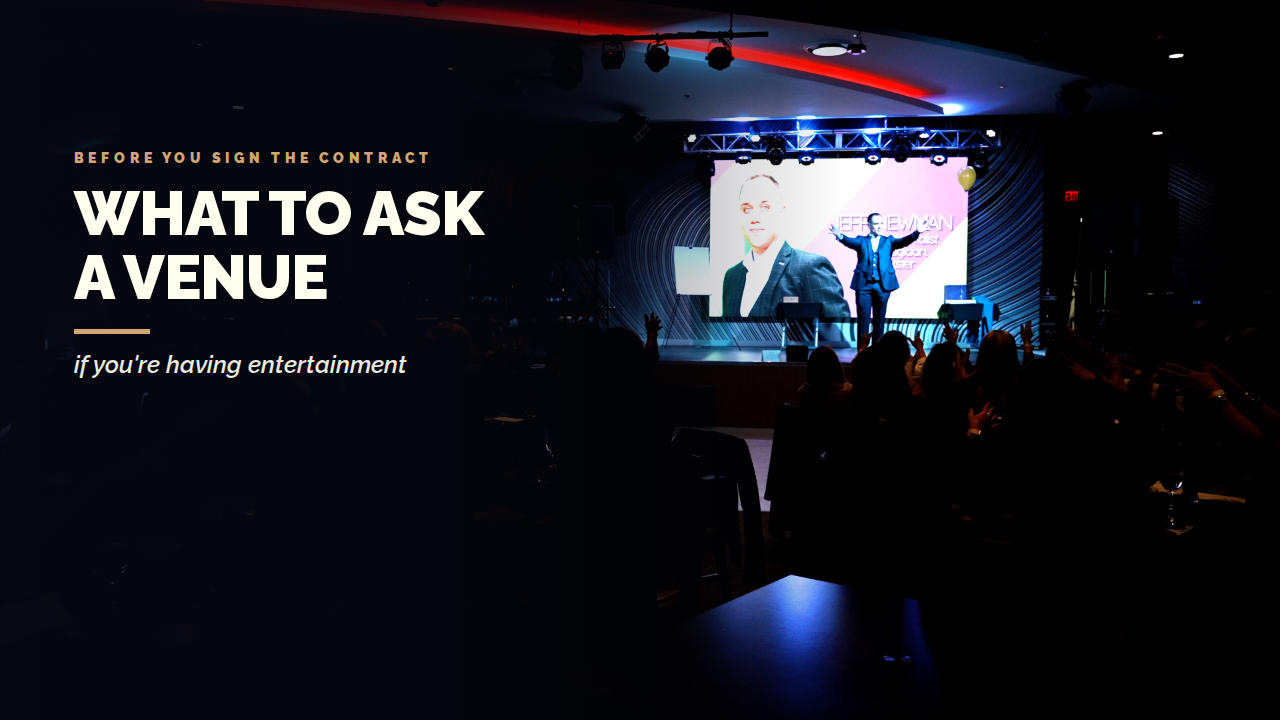
Most planners book the room first. It makes sense: the venue is the biggest line in the budget, the good ones go early, and everything else can be sorted out later.
Then the entertainment gets booked, and somewhere around the site visit you find out the “stage” is a corner of the carpet, the sound system is four ceiling speakers meant for background music, and there’s a structural pillar directly between two tables and the front of the room.
None of that is the venue lying to you. Ask a venue coordinator whether the room can host entertainment and they’ll say yes, because it can. They’re picturing a DJ. You’re picturing a show. Those need different things, and the gap only shows up when it’s too late to move.
Here’s what to ask before you sign, and why each one matters.
Is There a Stage, and Is It Actually Included?
Ask three things: whether there’s a stage or riser, what size it is, and whether it’s included in your rental or costs extra.
Riser height is the one people underestimate. A 12 or 16 inch riser is the difference between the back half of your room seeing what’s happening and the back half of your room watching the backs of heads. In a room of 150 or more, that’s most of your guests. A lot of hotel ballrooms and community halls own risers but store them offsite or rent them per section, and a few book them out to whoever asks first, so “we have a stage” and “you have a stage on your date” aren’t the same answer.
Worth saying: not every act needs one. In a smaller room, or for something built around close interaction, working on the floor is often better and warmer. But that’s a decision to make on purpose, not one to discover three weeks out.
Who Owns the Sound, and Does Anyone Know How to Run It?
“We have a sound system” covers everything from a proper front-of-house setup to a Bluetooth speaker behind the bar.
Ask whether there’s a microphone, whether it’s wired or wireless, and whether there’s a spare. Ask if a performer can plug into the house system or whether that’s blocked, since some venues require you to rent through their in-house AV company. Ask who is actually in the building running it on the night. In plenty of halls the answer is nobody, and the mic gets handed to whoever’s closest to the volume knob.
This is also a budget question, and it’s the one that surprises people most. Venues that include a room and food will often bill the microphone, the riser and the technician separately. If your quote doesn’t mention AV at all, that’s a question, not good news.
What Does the Room Look Like When It’s Full?
Empty rooms are liars. Walk it, or ask for a floor plan with the tables on it.
The things that quietly ruin sightlines are pillars, long narrow rooms where the far end is 60 feet from the front, and round tables, which are lovely for conversation and mean roughly half of every table has its back to the stage. Ask where the dance floor goes, because an empty dance floor between the tables and the stage pushes your whole audience further away than the floor plan suggests. Ask about ceiling height too, since low ceilings make a room feel intimate and also make a raised stage impossible.
If your room is on the smaller side, the sightline math changes completely, and what works in a smaller room is a different conversation.
Can You Turn the Lights Down?
Ask whether the room dims, whether there’s any light aimed at the stage area, and who controls it.
A room that’s either fully on or fully off is a real constraint. Full fluorescent lighting flattens everything and tells the audience they’re at a meeting. Fully dark means people can’t see their food or each other. What you want is the ability to bring the room down and put something on the performing area, even if it’s a single wash light. Plenty of venues can do this and simply never get asked.
Power, Load-In and How Early You Can Get In
Ask where the nearest outlet to the stage area is, whether there’s a loading door or whether everything comes through the front lobby, and what time the room is available for setup.
Access sounds like a small thing until you’re carrying gear up a flight of stairs past your arriving guests. The setup window matters more than most planners expect: if the room is booked for a lunch that ends at 4:00 and your doors are at 5:30, everybody is working in the same 90 minutes, and sound checks are the first thing to get squeezed.
What Does the Venue’s Timing Do to Your Night?
This is the question almost nobody asks, and it can shape the entire evening.
The kitchen decides your run of show more than you do. Ask when service starts, how long it runs, and when the kitchen closes. Ask whether there’s a noise curfew, when the bar closes, and what time you have to be out of the room. In a hotel with rooms above the ballroom, the curfew can be earlier than you’d guess.
You need this before you can place anything. A show works best after plates are cleared and before the room scatters, and a 45 to 60 minute set needs a real window rather than the 15 minutes left over between dessert and last call. If your party has grown to the point where the night needs a proper structure, that shift changes what you can run yourself.
Ask the Entertainer Too, Before You Sign
Any performer worth booking will tell you what they need in writing, and most of us would much rather answer these questions in July than solve them in December.
Send your act the venue name and ask if they’ve worked there. In Calgary, Edmonton, Vancouver, Victoria, Saskatoon, Regina and Winnipeg, a performer who works regionally has usually been in the room already and can tell you where the pillar is. If they haven’t, a good one will still ask you for a floor plan and the AV details rather than saying it’ll be fine. How an entertainer answers this is itself a decent test, and there’s more on separating a pro from an amateur if you’re comparing options.
The Short Version You Can Email
If you send a venue one message before signing, send this:
Is there a stage or riser available on our date, what size, and is it included?
What sound is in the room, is there a microphone, and is a technician included?
Can we see a floor plan with tables, and where do the pillars and dance floor sit?
Can the room lights be dimmed, and is there any light on the stage area?
What time can we get into the room, and where is the load-in?
When does food service end, when does the bar close, and is there a noise curfew?
Six questions, one email, before anybody signs anything.
Frequently Asked Questions
Do I really need a stage? Not always. It depends on the room and the act. Under about 80 guests, on a flat floor, a good performer can usually work without one. Past that, in a room with round tables, a riser stops being a nice extra and starts being the difference between a show and a rumour at the back tables.
The venue says they have AV. Is that enough? Sometimes. Ask what “AV” means in their case, because it ranges from a full rig with an operator to a mic in a cupboard. The specific question that sorts it: is there a person running sound on the night, and are they included?
What if we’ve already signed and the room is wrong? Most rooms can be made to work. Rented risers, a small portable sound system and moving the head table are all normal fixes, and your entertainer can usually tell you which one you need. It’s a cost and a conversation rather than a disaster.
Should I book the venue or the entertainment first? The date first, then whichever of the two is scarcer for your date, which in December is usually the act. If you’re flexible on the day of the week, that flexibility is worth more than most planners realize for both.
Ask Now, Not in December
None of these questions are difficult, and none of them will annoy a good venue. Sales coordinators would much rather answer six questions in a contract conversation than get a phone call at 4:00 on the day about a microphone.
The planners whose events run smoothly aren’t the ones with the biggest budgets. They’re the ones who asked what the room could do before they committed to it.
If you’re looking at a venue and want to know whether it’ll work for the kind of show you have in mind, get in touch.
