
The Psychology of Audience Participation: Why People Love (and Fear) Being Picked
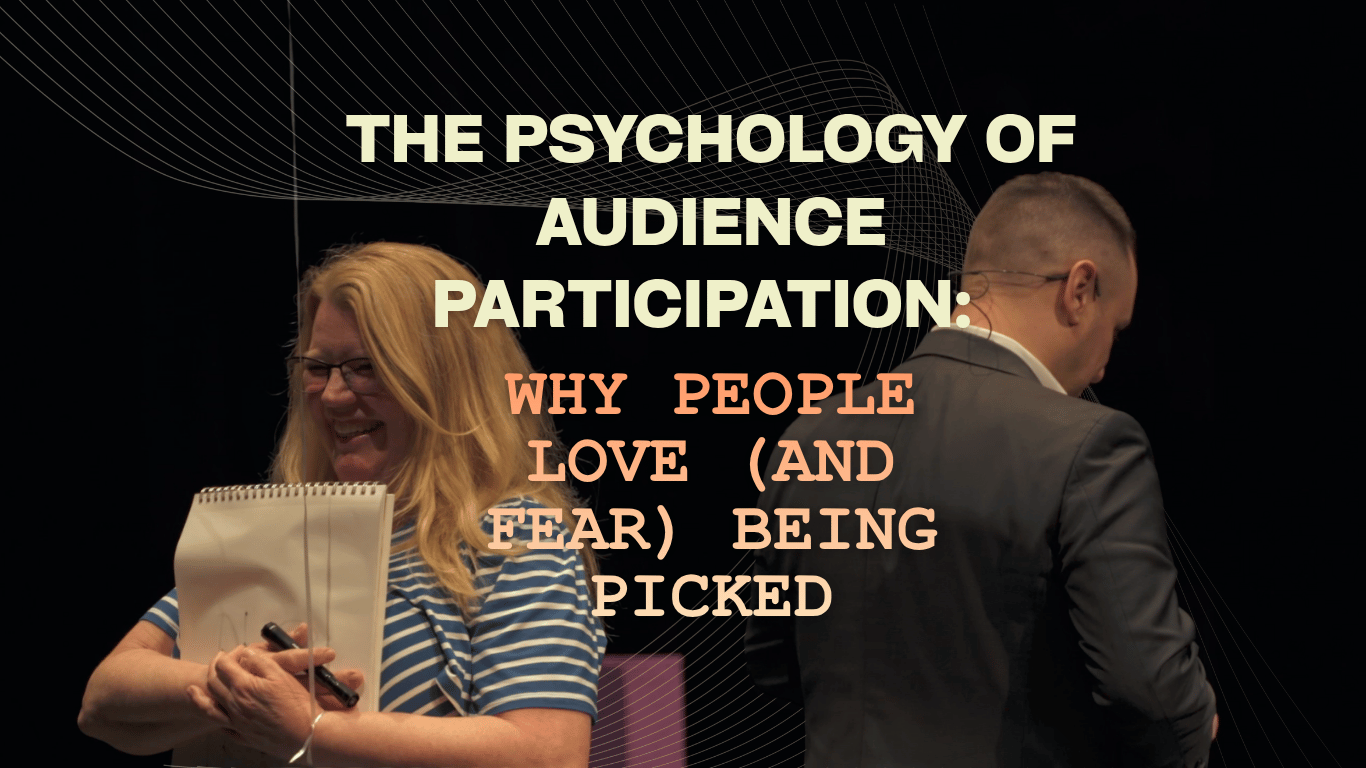
A few years ago I was performing at a corporate event in Calgary when I asked for a volunteer.
A woman in the third row sat very still, very deliberately, with the look of someone who had spent the entire dinner hoping nobody would do exactly what I was about to do. Her colleague at the same table, who I had clocked as the obvious volunteer type three minutes into the show, was already half out of her chair waving.
I picked the woman in the third row.
She walked up like she was being led to the principal’s office. She did the routine. It worked beautifully. Five minutes later she sat back down with the kind of look people have after they have done something they did not want to do and survived it. By the end of the night, her colleagues told me later, she would not stop talking about it.
That moment, the gap between how she felt when I called her up and how she felt fifteen minutes later, is a real thing. It is psychologically rich. And it is the reason audience participation, done well, is one of the most powerful tools a live performer has.
Here is what is actually going on in people’s heads when a performer points at them.
Why Being Picked Feels Like a Threat
The fear of being picked is older than performance. It is older than performance halls. It is older than anything humans have organized into evenings out.
The fear is social.
Humans evolved as a tribal species. For most of our history, being singled out from the group was extremely rarely a good thing. Being singled out meant being inspected, judged, exiled, or eaten. We carry that wiring with us into the modern hotel ballroom, even though the wiring is wildly miscalibrated for the actual stakes (mild embarrassment in front of strangers we will likely never see again).
When a performer points at someone, a few things happen in that person’s nervous system at the same time.
The threat-detection system fires. Heart rate spikes. Hands warm or cool. Attention narrows. The audience member is, for a few seconds, in a mild fight-or-flight state. They are now scanning for danger, even though no real danger is present.
Self-consciousness kicks in. The audience member becomes intensely aware of how they look, what they are wearing, whether they look ridiculous, whether they have something in their teeth. Psychologists call this heightened state self-focused attention. It is the same state that makes giving a wedding toast feel harder than it should.
Future-thinking dominates. Instead of being in the moment, the audience member runs simulations of what is about to happen. Most of those simulations are catastrophic. “What if I cannot do it. What if I look stupid. What if I fail in front of my boss.” Almost none of those simulations turn out to be accurate.
This stack of reactions happens in seconds, and it happens whether or not the audience member has any rational reason to be worried. The wiring does not care about the rational analysis.
Why Being Picked Also Feels Amazing
Here is the part that surprises people.
The same wiring that makes being picked feel like a threat also makes being picked feel like a peak experience. The catch is that the peak does not happen in the moment of being picked. It happens shortly afterward, when the threat does not materialize.
Psychologists call this misattribution of arousal. When your body is in a heightened state and the situation resolves positively, you do not just feel relief. You feel exhilaration. The brain attributes the heightened state to the positive outcome. The result is a much stronger positive emotion than you would have felt if you had been calm the whole time.
This is the trick. The audience member who walks up scared and sits back down having survived a moment of public attention is not just relieved. They are lit up. They have just done a thing they thought they could not do. The dopamine that fires when humans complete a challenge they were unsure about is one of the most reliable mood lifters in the catalogue.
This is why so many of the volunteers I have ever pulled on stage end up telling me, hours later or weeks later, that it was the highlight of their event. They did not enjoy being picked. They enjoyed having been picked.
There is a real difference between those two things, and the best live performers understand it.
Why Some People Light Up Right Away
Not everyone gets the threat reaction.
A subset of audience members (call it 10 to 20 percent of any corporate room) genuinely welcomes the attention. They have learned, from a lifetime of social practice, that being singled out is usually a positive experience. They have read their colleagues correctly. They know how their voice carries. They know they will perform well. They have no fear-of-failure reaction in this context.
These are the “obvious volunteers.” The ones who half-raise their hand the moment the performer asks. Often they are the planner who hired you, a senior executive who is used to public attention, or a sales rep whose entire job is being unfazed in front of strangers.
A common rookie performer mistake is to take this volunteer every time. It seems safe. The energy is high, the volunteer is at ease, the routine clicks.
The mistake is that the audience does not get the benefit of the misattribution effect. They are watching someone who was already comfortable. There is no transformation. The routine works, but the room does not get the emotional payoff of seeing a fellow regular human get pulled into something and survive it. The reaction stays at the level of “neat trick” rather than “I cannot believe what just happened to her.”
The best performers I know mix the two. They will sometimes use the obvious volunteer for an early routine because it lowers the room’s overall fear (everyone is watching someone confident, so the room relaxes too). Then later in the show, when the room is warm, they will pick someone who came in afraid. That is the moment the show gets memorable.
The Performer’s Job Is Not What You Think
The implicit job description of an audience-participation performer is “use the volunteer to perform the routine.”
The actual job is closer to “make the volunteer’s experience the centrepiece of the routine.”
This is a real distinction. A performer who treats the volunteer as a prop will get through the routine. A performer who treats the volunteer as the subject of the routine will get through the routine and leave the volunteer feeling like a million bucks.
The mechanics of doing this well are small. They are also non-negotiable.
Do not punch down. Never make the volunteer the butt of the joke. The audience laughing at the volunteer is the cheapest, worst form of audience laughter. The audience laughing with the volunteer, or laughing at the impossibility of what just happened, is the right kind.
Read the volunteer’s actual comfort. Some people will play big when they are nervous. Some people will go quiet. The performer’s job is to dial up or dial down their own energy to match. A nervous volunteer does not need a performer cranking up the pressure. They need a performer holding the moment for them.
Hand the credit back. When the routine works, the credit goes to the volunteer. “She nailed it.” “Look at this. He just did the impossible.” The audience experiences the volunteer as the hero of the moment, even though the performer is the one who built the moment.
Walk them down clean. A returning volunteer should leave the stage with a clear cue (the round of applause, the handshake, the seat back at the table). No lingering, no awkward exits. The clean return ends the spike of self-consciousness and lets the brain transition back to normal.
Done right, the volunteer’s experience curve looks like a small mountain. Anxiety on the way up, peak in the middle, relief and then exhilaration on the way down. Done poorly, the curve has a long aftermath of mild embarrassment that the volunteer will tell their friends about with a wince rather than a grin.
What This Means for Corporate Events Specifically
If you are a planner choosing entertainment for a corporate event, the audience-participation psychology is worth thinking about.
A few practical implications.
Hire a performer who treats volunteers well. Watch the demo reel for how the performer interacts with the audience. If the reel is heavy on volunteer-reaction shots, look at the volunteers’ faces during and after the routine. If the routine reads as “the performer used them” rather than “the performer made them the hero,” that performer is not the right fit for your corporate room.
Avoid acts that depend on humiliating volunteers. They exist. Some of them are funny in the moment. None of them are good for the volunteer the next morning at work. The wrong volunteer humiliation at a holiday party becomes an HR conversation.
Lean into formats that handle the participation well. Mentalism, in particular, tends to put the volunteer on the receiving end of an impossible moment rather than the punchline of a joke. So does close-up magic. So does the better end of corporate comedy. Lean toward formats where the volunteer is the subject, not the prop. (For more on how to think about format choice for corporate audiences, there is a comparison piece here.)
Trust the post-show feedback. The volunteer’s experience the morning after is the real measure of whether the entertainment worked. If volunteers are still happy a week later, the act handled the participation well. If they are quietly avoiding the story, it did not.
Why It All Matters
A live performance is one of the few remaining contexts where strangers in a room agree to share an experience in real time. Audience participation is the moment that shared experience becomes specifically personal. A single member of the room steps forward, and the rest of the room watches what happens to them.
The performer’s job is to honour that. To take the volunteer’s fear seriously, to use it just enough to create the emotional shape of the routine, and to hand them back to their seat better than when they left it.
When that goes well, the result is one of the most memorable moments in any corporate event. Not because the trick worked, although it should. Not because the volunteer was the right pick, although they were. Because for a few minutes, the volunteer thought something difficult was about to happen and then it turned out to be wonderful instead.
That gap between expectation and reality, between fear and exhilaration, is the entire reason audience participation exists in the first place.
If you are curious about how this kind of thing plays at corporate events, or just want to chat about whether mentalism is the right fit for an event you are planning, I would love to hear about it. Tell me about your event on the corporate entertainment page.
