
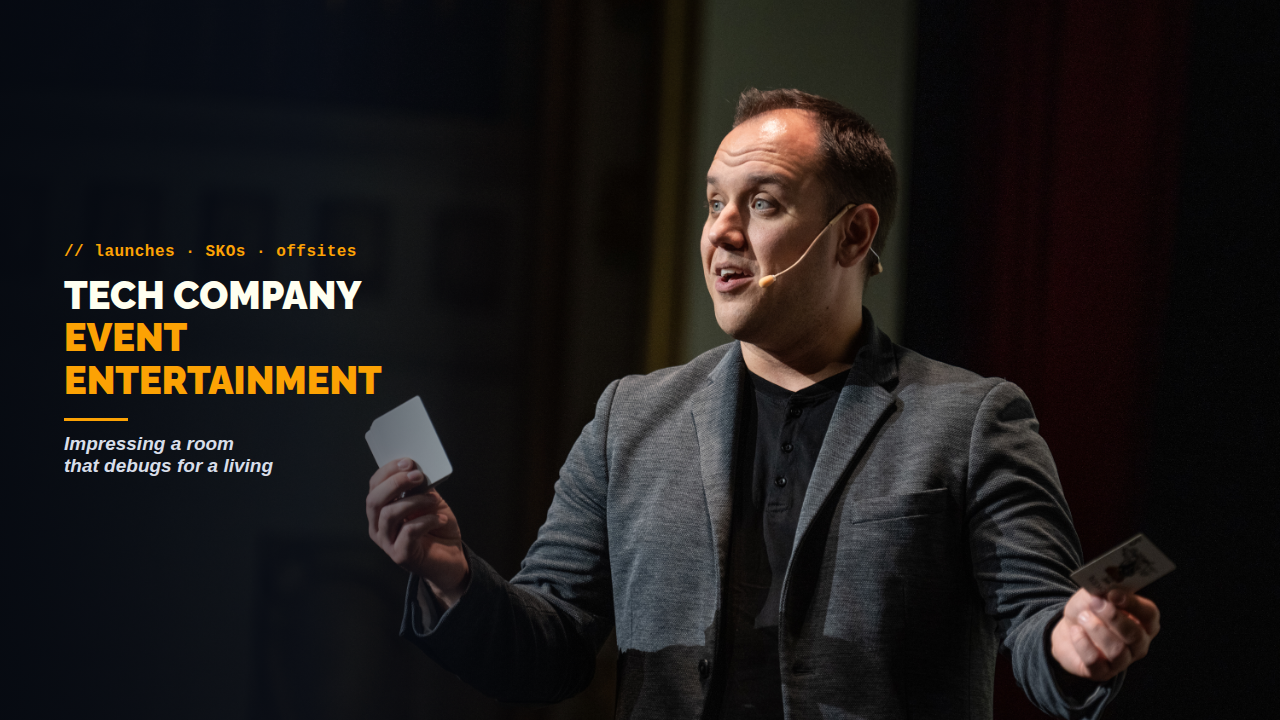
Tech companies throw a lot of events: product launches, sales kickoffs, dev team offsites, holiday parties, user conferences, funding celebrations. And tech audiences are, by reputation and in my experience, one of the tougher rooms to impress. They build systems for a living, and the instant a performer walks on stage, half the room starts trying to debug the trick.
That instinct scares off a lot of acts. It’s exactly why I love performing for these rooms, and this post covers what to know when you’re booking entertainment for a crowd that will absolutely try to take the show apart.
What Makes a Tech Audience Specific
Three things stand out from the tech events I’ve played across Calgary, Edmonton, Vancouver, Saskatoon, and beyond.
First, they’re pattern-matchers. A tech crowd doesn’t watch a show; it reverse-engineers one in real time. Entertainment that survives that scrutiny earns more credibility with this audience than with any other, and entertainment that doesn’t gets quietly rated two stars over drinks.
Second, they’re allergic to cringe. Anything that smells like forced fun, trust falls, or mandatory audience participation hits a wall of folded arms. Participation has to be earned and voluntary, or it curdles.
Third, the room is more mixed than the stereotype: engineers next to sales next to customer success next to the founders, plus partners at evening events. Median age skews younger than most corporate rooms, but not uniformly, and the show has to hold the whole distribution.
Why Mentalism Plays So Well in Tech Rooms
A mentalism show is, structurally, a puzzle the room can’t solve, presented by someone who openly admits it’s a puzzle. I tell audiences plainly: no psychic powers, this is skill. For a crowd that debugs for a living, that framing turns the whole show into the best kind of problem. They lean in instead of back.
And because the material is generated from the audience’s own minds (their thoughts, their choices, their unspoken decisions), there’s no canned script to see coming. The engineers can’t find the seam, the founders get a moment on stage, and the show becomes the thing the team argues about in Slack for a week afterward. (That last part is not a joke; I’ve been shown the threads.)
If you’re comparing acts, the fastest quality check is watching real performance footage the right way: a few unbroken minutes in front of a real corporate crowd, not a highlight reel.
Common Tech Event Types I Work
Sales kickoffs are the big one: high energy, big goals, a room that needs to leave believing. (I’ve written about sales kickoff entertainment specifically, because SKOs have their own physics.) Holiday parties are the classic dinner-plus-show format, with material clean enough for the HR-reviewed era; my breakdown of what corporate-clean means is effectively a compliance doc for entertainment. Offsites and team weeks are a different rhythm: a show slots into one evening without eating the agenda, and it gives remote-first teams a shared in-person memory, which is half the point of flying everyone in. And then there are launches, milestones, and funding parties. When the company has something to celebrate, entertainment marks the moment as an occasion instead of just a bar tab.
Mistakes I See at Tech Events
Booking entertainment that condescends to the room, or the opposite: assuming a smart audience only wants smart-sounding content and giving them a lecture with jokes. Scheduling the show after the open bar has been open too long. And for distributed teams, treating the in-person gathering as logistics instead of the product; the event is the product, and entertainment is a feature, not a patch.
Frequently Asked Questions
Our team will try to figure out the tricks. Is that a problem?
It’s the fun part. The show is built for skeptical, analytical rooms; scrutiny makes it play better, not worse. I encourage the debugging; nobody’s cracked it yet.
Can you perform at an offsite venue or a rented space?
Yes. The show is self-contained and travels to hotels, venues, offices, and the mountain towns tech teams love for offsites. Banff and Canmore are regular stops; I’ve written about mountain retreat events separately.
Do you do virtual shows for remote teams?
Short answer: gather in person. Virtual entertainment faded from my bookings entirely, and in-person gathering is exactly the thing distributed teams are missing. I’d rather be one more reason to fly the team somewhere.
What does it cost?
Scope-driven: audience size, format, length, travel. One clear number up front, and my published cost guide has realistic ranges for planning.
Ship the Event They’ll Actually Remember
A tech team that can’t figure out how the thing worked will talk about it longer than any swag drop or keynote. If your kickoff, offsite, or holiday party needs a centerpiece that survives a room full of debuggers, get in touch and tell me about the event.
