
Conference Entertainment in Western Canada: How to Pick the Right Act
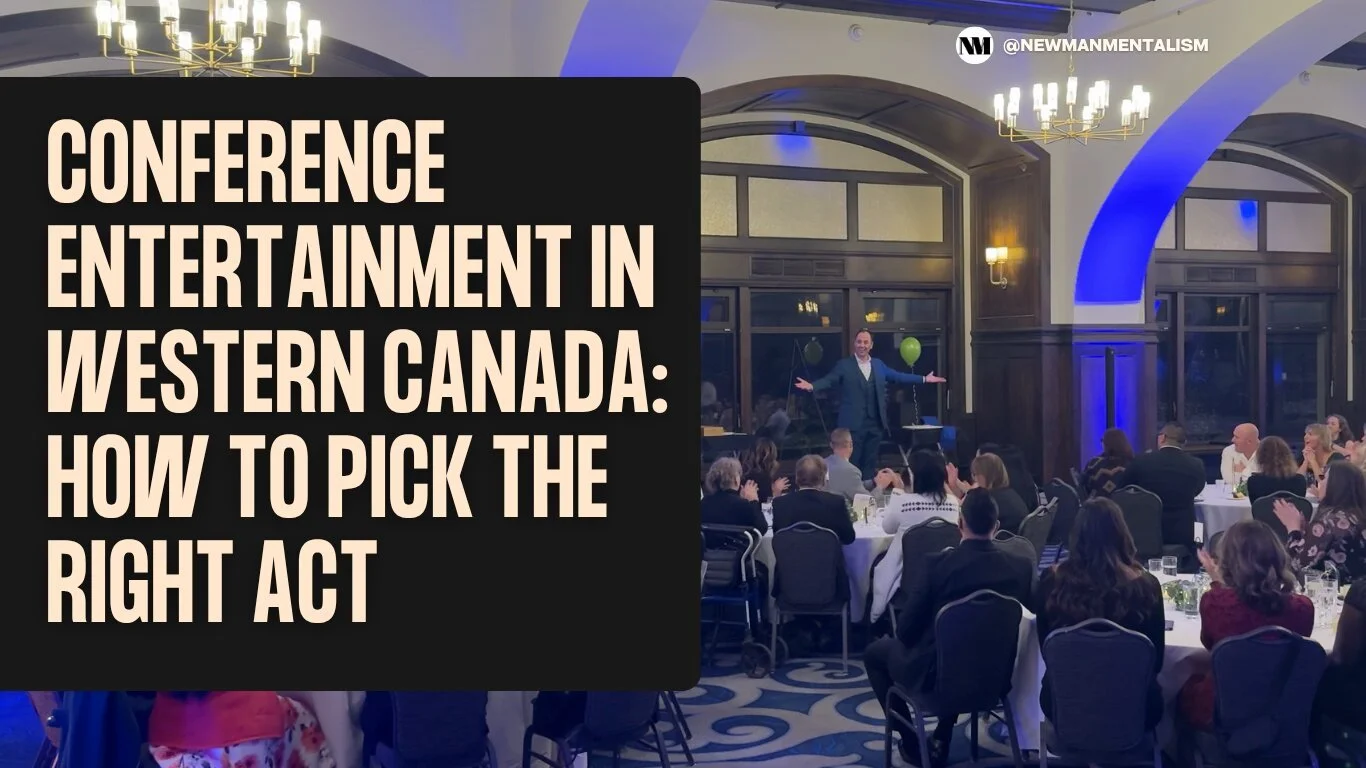
Conferences are weird events to entertain.
Think about it. You've got a room full of people who have been sitting in chairs for eight hours, half of them are still chewing through the keynote they sat through this morning, and the other half are checking emails under the table because their inbox didn't pause for the breakout sessions. Now you, the planner, are supposed to put a performer in front of them and have them care.
And here's the thing nobody tells you: most of the entertainment that "works" at a gala or holiday party does not work at a conference. Different room, different energy, different stakes. I've performed at hundreds of corporate events across Western Canada, and the conferences are the ones where I've watched event planners realize, mid-room, that they hired the wrong act.
So let's fix that.
Consider this a planner's guide to choosing conference entertainment that won't fall flat. The principles apply anywhere, but I'll lean on examples from Calgary, Edmonton, Banff, Saskatoon, and Winnipeg, since those are the rooms I know best.
Why Conferences Are a Different Beast
A gala is a celebration. A holiday party is a party. A conference is a job.
People are at conferences because their company sent them, or because they're trying to learn something, or because the industry effectively requires them to be there. That changes the entertainment math in three big ways.
The crowd is tired. By the time entertainment shows up (usually at dinner or the closing reception), your audience has been in sessions since 8 a.m. They don't want to work to enjoy something. They want to be entertained at them, not by them.
The crowd is mixed. Conferences pull people from every level of the org chart, every department, and often from competitive companies. A bit that lands with the VP table might bomb at the table of new hires three rows back, and vice versa. The entertainment has to hold a wide room.
The stakes are visible. A bad gala is a story you tell over coffee a week later. A bad keynote at an industry conference is a story that follows the planner around the rest of the year, because every single attendee has the same anecdote.
That's a lot to ask of "the guy with the guitar at the dinner."
What Actually Works on a Conference Crowd
After enough of these events, you start to notice patterns in what works and what doesn't.
Interactive, not passive. A solo guitar player at the back of the room while people eat? That's background music, not entertainment. People want to be pulled out of the conference fog, and that takes something they have to actually pay attention to.
Quick to engage, slow to wear out. Conferences run long. The opener in particular has to grab attention in the first 30 seconds, but also hold a room for 45 to 60 minutes. Acts that frontload their best material run out of fuel halfway through.
Smart, not silly. This is the big one. Your audience is at a conference, which means they (mostly) think of themselves as smart, professional adults. They will tolerate, but not love, an act that talks down to them. The entertainment that crushes at a conference is the entertainment that gives the audience credit.
Clean by default. I cannot overstate this. The blue comedian who killed at someone's stag in Vegas is a career-limiting move at an oil and gas industry conference in Calgary. Your performer has to be PG-appropriate without being told.
Adaptable in real time. Conferences run late. Sessions run long. The lunch line for 600 people takes longer than the catering promised. A pro can shorten, lengthen, or compress on the fly. An amateur can't.
Full disclosure: I'm a mentalist, and mentalism ticks most of those boxes by design. It's interactive, it gives the audience credit for being smart, and it adapts to the room. But the criteria above apply to any act, not just mine. Hire by the criteria, not by the format.
Match the Entertainment to the Day Part
When does the entertainment show up at the conference? This changes everything.
Morning opener. You're competing with caffeine. The job is to wake people up and set the energy for the day. Short, punchy, high-impact. 20 to 30 minutes max. Long form is wasted here.
Lunch and learn-style breaks. The trap is "background entertainment" that nobody actually pays attention to. Either commit to a real act with the audience seated and looking, or skip it entirely and just pipe in music. There is no good middle ground.
Closing keynote slot. This is where the big swing happens. You've got a tired room that wants to feel like the day was worth it. A 45- to 60-minute headline act in this slot is the most-remembered part of the whole conference. Spend the budget here.
Evening reception. Cocktails and conversation. Strolling close-up magic, mingling mentalism, or anything that works in small clusters of 6 to 10 people is gold. A stage show competes with the bar. Close-up doesn't.
The hospitality suite or off-site dinner. Smaller, looser, and often the executive group. Different vibe entirely. Treat it like a private show.
If your conference has multiple slots, you do not need the same entertainer for all of them. In fact, you probably shouldn't.
Questions to Ask Before You Book
If you're vetting a performer for a conference, these are the questions that separate pros from amateurs:
Have you performed at conferences in our industry before, and what did you do? (If they hedge, that's information.)
Walk me through your day-of timeline. When do you arrive, what do you need from us, and what do you handle yourself? (Pros have an answer. Amateurs improvise.)
What's your tech rider, and how flexible is it? (A good performer hands you a clean rider and adapts where they can. A bad performer either has no rider or has a rider that reads like a rock star's contract.)
What happens if our schedule shifts? (Conferences shift. The answer should not be a sigh.)
Can you provide insurance, references, and/or a video from a comparable event? (If you have to ask twice, move on.)
Are you willing to customize anything for our company or industry? (For mid-to-large industry conferences, the answer should be yes within reason.)
I'd also add one less obvious question: who else are you booked with this year? You're not looking for name-drops. You're looking for evidence that the performer is working at the level you're hiring at. A calendar full of small bars and weekend birthday parties is not the same career as one with Imperial Oil, TD Bank, Bell, Bayer, Siemens Energy, and Re/Max on it, or one with cruise headliner contracts for Princess, Celebrity, Cunard, and Virgin. Pick accordingly.
A Western Canada Planner's Checklist
Western Canada has its own conference rhythm. Oil and gas, agriculture, construction, manufacturing, energy services, government, and the resource-adjacent industries run a big chunk of the annual conference calendar in Alberta, Saskatchewan, Manitoba, and BC. A few practical notes:
Book early for Q1 and Q4. Industry conferences cluster around the start of the calendar year and again before the holiday slowdown. Top performers in Western Canada get booked 4 to 6 months out for these windows, sometimes longer. If your conference is in February, you should be having the entertainment conversation in October. (More on lead time here.)
Banff and the resort circuit are a category of their own. Mountain conferences and executive retreats have their own logistics: longer drives, smaller venues, and often a more intimate executive audience. Pick performers who do this routinely. The "guy who killed at the Hyatt downtown" is not always the right pick for the executive retreat at Fairmont Banff Springs.
Calgary and Edmonton get the volume; secondary cities reward detail. A conference in Red Deer, Lethbridge, Saskatoon, or Kelowna is often a more attentive room than a 2,000-person convention in a big-city hotel ballroom. The energy is different, and the entertainment should match.
Cross-province travel is real budget math. If you're a planner in Winnipeg or Vancouver booking a Calgary-based act, ask the performer up front whether travel is included in their fee or quoted separately. (For what it's worth, mine is.)
You don't always need a local act. But if your performer needs to be reliable, on time, and easy to work with in a Western Canadian conference setting, hiring someone who does this every week beats hiring an out-of-country performer who's never seen the inside of a Calgary or Saskatoon ballroom.
Hire On Purpose
A conference is, more than any other event type, a referendum on whether the planner picked the right pieces. The keynote speaker can be brilliant. The catering can be perfect. The breakout sessions can be tight. And one weak entertainment slot will be the thing people remember.
So pick on purpose. Hire someone whose day job is conferences, not someone whose day job is birthday parties who'll do a conference because you asked. Match the act to the slot. Ask the boring questions. And book early.
If you're planning a conference in Calgary, Edmonton, Banff, Saskatoon, Regina, Vancouver, Winnipeg, or anywhere else in Western Canada and you want a closing act your audience will still be talking about in the elevator the next morning, I'd love to hear about it. Tell me about your event over on the corporate entertainment page, and we'll see if I'm the right fit.
